Namibia is unusual because the strongest case for solids-handling equipment does not come from one sector alone. It comes from the intersection of offshore oil and gas development and uranium mining growth. Reuters reported in April 2026 that BP agreed to take a 60% operating stake in three offshore Namibian licenses, marking its operating entry into a country that hopes to produce its first oil by 2030. Reuters also reported that TotalEnergies and Petrobras expanded into PEL104, while Shell prepared a new drilling campaign from April 2026. At the same time, Reuters reported that Namibia passed 10,000 metric tonnes of uranium oxide output in 2025, reinforcing its status as the world’s third-largest uranium producer. That combination means the operating challenge is not only about exploration headlines; it is about the dirty work that follows drilling, storage, marine support, processing, and mine maintenance.
Namibia’s offshore story is still pre-first oil, and that matters. There is not yet large-scale national hydrocarbon production, but there is a rapidly intensifying exploration and appraisal environment. In that kind of setting, an offshore sludge pump Namibia operators and service contractors can trust becomes relevant for drilling mud, cuttings, slops, vessel-bottom residue, marine spill recovery, and tank-maintenance work around support infrastructure and future development assets. Reuters’ reporting on offshore acreage deals, renewed drilling, and first-oil ambitions confirms that this is no longer a speculative geography. It is an active operating frontier. That is why Supavac pumps in Namibia deserve attention now rather than later.
A tank cleaning pump that Namibia marine and energy contractors can deploy safely is equally relevant. Supavac’s official applications page lists tank cleaning/desludging, slops sump cleaning, oil sludge and tank-bottom residue transfer, FPSO tank cleaning/desludging, bilge cleaning, and vacuum cleaning of barge and vessel bottoms. Even though Namibia is not yet an FPSO-producing country, those applications still map well to offshore support, marine logistics, maintenance campaigns, and the type of hydrocarbon-residue problems that appear as fields move toward development and port-side activity grows.
On the mining side, the case is just as practical. A uranium slurry pump that Namibia mines can rely on has to handle abrasive slurry, pond residue, settled solids, thickener buildup, and sump accumulations under difficult site conditions. Reuters specifically noted that the country’s major uranium mines operate in arid conditions, and that Namibia wants to cement its role after record output in 2025 while new projects such as Etango and Tumas move through the pipeline. In arid conditions, inefficient cleanup and repeated rehandling are particularly costly because every extra step complicates water, labour, and maintenance control.
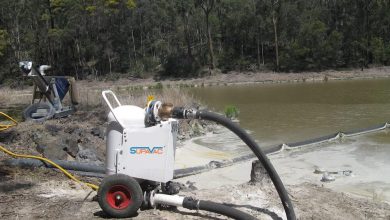
A sump cleaning pump Namibia plants can move quickly into shafts, pits, underflow areas, and drain points, and is therefore not a minor procurement choice. Supavac’s mining applications explicitly include sump/pit cleaning & desludging, transfer of mining slurries, mud and tailings transfer, thickener spill management/desludging, tailings and pond cleaning, and hazardous waste recovery. Those are core operating problems for uranium and other hard-rock mining environments, not side cases. A recurring mistake at the site level is to treat them as chores that any pump can handle. In reality, once the material becomes solids-heavy, abrasive, or inconsistent, the cleanup system has to be chosen for the material rather than the line size.
This is why conventional pumping often underperforms in Namibia’s most relevant use cases. Offshore slops and tank residues are rarely clean or predictable, and mining slurry is rarely thin or uniform. Once drill cuttings, oily residues, settled fines, thickened pulp, pond sludge, or contaminated water enter the picture, sites start paying for the wrong assumptions: more hose clearing, more stoppages, more manual intervention, more cleaning cycles, and longer maintenance windows. Supavac’s official positioning is different. The company describes its systems as 100% air-powered, intrinsically safe solids-vacuum pumps for difficult, solids-laden material, with published use cases spanning marine sludge, hazardous waste, mining slurry, tailings, and spills.
This is where Supavac pumps in Namibia fit more convincingly than generic transfer equipment. The fit is not based on a vague “energy country” argument. It is based on documented alignment between what Namibia now generates operationally and what Supavac officially says it handles: offshore sludge, marine waste, tank residue, drill cuttings, sump buildup, mining slurries, tailings residue, and hazardous waste recovery. That is a much stronger commercial narrative than treating Namibia as a generic industrial market.
Model comparison for Namibian offshore and uranium work
| Model | Published max suction lift/recovery figure* | Recommended materials | Typical Namibian applications | Mobility | Published air consumption |
| SV110-V2 | Recovers from up to 50 m and discharges beyond 500 m; up to 25″Hg+ vacuum | Heavy sludge, mining slimes, drilling mud, spills, hazardous residue | Offshore spill response, drill-area cleanup, sump and shaft cleaning, tailings and ash pond cleanup, and rapid maintenance access | Mobile wheel/skid-mount format | Minimum 280 cfm at 85–100 psi |
| SV250V | Vertical suction lift to 30 m; recovers flowing slurries from up to 50 m and delivers up to 1000 m | Heavy sludges, uranium-process slurry, oil sludge, tank bottoms, hazardous waste | Tank-bottom residue transfer, marine sludge cleanup, uranium slurry movement, thickener desludging, hazardous recovery | Compact heavy-duty unit; roll-frame / fixed-duty style | 150–750 cfm depending on jet-pack configuration |
| SV280V | Heavy-duty unit with up to 25″Hg+ vacuum; delivery up to 1000 m horizontally and 35 m vertically | High-density slurries, tailings, tank bottoms, OBM residue, sand-laden waste | High-density uranium slurry handling, pond cleanup, tailings transfer or dewatering, tank-bottom extraction, pit cleaning | Fully enclosed fixed heavy-duty package | Minimum 600 cfm at 85–100 psi |
| SV510 | Up to 28″Hg vacuum; high-throughput vacuum load or top-load gravity feed | Drill cuttings, mud, sludge, mining slurry, heavy aqueous waste | Higher-volume offshore slops and cuttings work, large pond or sump cleanup, heavy marine or mine residue capture | Compact heavy-duty skid footprint | 600–750 cfm depending on discharge configuration |
*As with the Zambia matrix, the table uses the closest published lift or recovery figure available on current official Supavac literature because not every product page publishes an identical “max suction lift” field.
An offshore sludge pump that Namibia operators can use in space-constrained response work is where the SV110-V2 becomes especially relevant. Supavac’s technical sheet places it in offshore drilling, oil, gas, and mining, and explicitly lists large-scale spill recovery, tank cleaning, sump and shaft cleaning, hazardous waste recovery, and drilling mud and cuttings transfer. That is important in Namibia because much of the near-term demand is likely to come from service and support tasks rather than mature long-life production infrastructure.
A tank cleaning pump, Namibia operators can deploy for heavier residue points more directly toward the SV250V. Supavac positions the model for heavy sludges, hazardous waste, and mining-slurry transfer, and its published 30-metre vertical suction lift plus long-distance discharge capability make it especially relevant when residue has to be lifted out of awkward spaces and discharged to a controlled point. For marine tanks, sumps, or uranium-process residue, that is a practical rather than cosmetic advantage.
For a uranium slurry pump Namibia sites can use against denser or more abrasive material, the SV280V moves up the priority list. Its official literature directly names high-density slurries, tailings transfer or dewatering, sump cleaning and desilting, tank bottoms and sludge extraction, and OBM transfer and pit cleaning. That gives it a useful crossover position for Namibia because the same country needs both mining-duty solids handling and offshore-related high-density waste movement.
Where a sump cleaning pump Namibia maintenance crew wants for frequent, awkward, or access-limited work, the SV110-V2 remains the most flexible mobile option. Where the job is repeated, denser, or larger, the SV250V and SV280V become more credible. And where the campaign is bulkier or timed against tight shutdown windows, the SV510 is the stronger conversation because Supavac publishes it for high-density slurry capture and throughput up to 90 m³/hr at SG1.0.
One important offshore proof point comes from Supavac’s published FPSO tank-cleaning case study. While not Namibia-specific and not built around the four models in the table, it documented a product-family result of 7–10 tanks per day per crew, a 50% reduction in on-site personnel, and a major acceleration versus manual sludge-removal methods. In a Namibian market moving toward first oil and growing marine-service activity, that kind of documented family capability is commercially relevant because it shows what the technology category can do in hazardous tank-cleaning environments.
Namibia’s operational logic is therefore twofold. Offshore, buyers need safer ways to recover sludge, slops, cuttings, and contaminated marine residue as drilling and development activity build toward first oil. Onshore, uranium and hard-rock sites need reliable ways to move dense slurry, clean sumps, manage tailings residue, and recover difficult solids in arid operating conditions. The same product family addressing both sides of that equation is rare. That is why Supavac pumps in Namibia are easier to position as a solution platform than as a single-product pitch.
In short, Supavac pumps in Namibia are not a forced-fit proposition. They line up with the country’s real operational mix: exploration-led offshore sludge problems today, growing marine and tank-cleaning needs tomorrow, and already-established uranium mining slurry and cleanup burdens onshore. That makes Namibia one of the strongest next-step African markets for application-led Supavac positioning.
Namibia publishing assets, FAQ, keywords, and final audit
FAQ
What are the Supavac pumps in Namibia most relevant for today?
The best-fit current use cases are offshore drilling and marine-support waste recovery, tank and bilge cleanup, sump and pit cleaning, uranium-process slurry transfer, thickener residue handling, and hazardous solids recovery. That mix follows directly from Reuters’ picture of Namibia’s offshore growth and uranium scale, together with Supavac’s official application list.
Which model works best as an offshore sludge pump that Namibia contractors can deploy quickly?
The SV110-V2 is the clearest starting point for mobile offshore response, spill recovery, cuttings transfer, and awkward-access cleanup because Supavac’s technical sheet explicitly places it in offshore drilling, tank cleaning, and hazardous-recovery use cases.
What makes a tank cleaning pump, Namibia operators can trust, different from a basic transfer pump?
Tank residue is often oily, solids-laden, sticky, and inconsistent. Supavac’s official marine and oil-and-gas applications focus on exactly that type of difficult material, including tank bottoms, slops sumps, bilge cleaning, and sludge transfer.
Which option is strongest as a uranium slurry pump Namibia mines can use for heavier residue?
The SV250V is a strong all-round option for heavier sludges and mining slurries, while the SV280V becomes more attractive when density, abrasiveness, or dewatering-style duty rises.
Why does a sump cleaning pump for Namibia mines need to be chosen carefully?
Because settled solids, abrasive pulp, and dense residue do not behave like a clean liquid. In Namibia’s uranium context, that becomes even more important because the mines operate in arid conditions where inefficient cleanup and repeated handling are costly.
How important is hazardous waste recovery in Namibia’s case?
Very relevant. Hazardous waste recovery appears explicitly in Supavac’s mining, industrial, and oil-and-gas application lists, making it commercially useful in both offshore contamination-response work and mine-process residue management.
Call to action
If your operation is evaluating offshore sludge recovery, marine tank cleanup, bilge residue handling, uranium-process slurry transfer, or difficult solids removal, the question is not whether Namibia has a use case. It does. The real question is which model fits the material, access, and throughput profile best. For application advice, model selection, and supply support, contact [Takmeel Global General Trading LLC](https://takmeeltrading.com/?utm_source=chatgpt.com).
Takmeel Global General Trading LLC
Office#315, Makatib Building
PO Box 85250, Port Saeed
Deira, Dubai, UAE
Phone: +971 52 692 2575 | +971 04 256 4920
Email: info@takmeeltrading.com