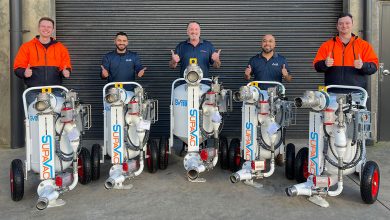
Summer heat indices on Gulf job sites regularly exceed 50 °C. Add engine exhaust, welding arcs, and abrasive dust, and you have a recipe for heat stress, lower productivity and unplanned shutdowns. Enter the high‑pressure mist cooling system UAE operators are adopting to flash‑evaporate micro‑droplets, knock down airborne dust, and restore workable ambient conditions—all while consuming far less energy than conventional HVAC.
This guide covers:
- The physics of atomization and flash‑evaporation.
- Core components—pumps, stainless lines, anti‑drip nozzles, filtration.
- Industrial use cases from drilling‑rig maintenance bays to Ras Al Khaimah shipyards.
- Safety and environmental benefits, including dust & heat‑suppression mist.
- Installation and maintenance support offered across the UAE and wider GCC.
- A concise FAQ on water quality, power draw, automation and system life.
Whether you manage a mist‑cooling system Dubai retrofit for an open‑air fabrication shed or specify a new industrial misting system UAE‑wide for an offshore module yard, the checkpoints below will streamline your decision‑making.
How High‑Pressure Mist Cooling Works
Atomization
A positive‑displacement plunger pump raises potable water to roughly 70 – 100 bar.* At the nozzle orifice—typically 0.15 – 0.30 mm—the liquid shears into ≤ 10 µm droplets. The surface area of one litre of water expands from ~0.05 m² to over 250 m², accelerating heat exchange with the surrounding air.
Flash‑evaporation
Because Gulf relative humidity often hovers below 60 % at peak heat, those micro‑droplets absorb latent heat and vaporize within 1–2 m of the nozzle exit, delivering a local temperature drop of 5 – 12 °C without noticeable wetting.
No wet floor
Anti‑drip valves close instantly below 30 bar, preventing puddles that could cause slip hazards around drill‑string racks or shore‑power cables.
*Pressure and orifice ranges taken from commonly published OEM specifications; always verify with your equipment vendor.
Key Components: Pumps, Stainless Lines, Nozzles, Filtration
| Component | Typical Spec | Why It Matters |
| Plunger Pump | 316 SS / ceramic plungers, 70–100 bar, 1–3 kW motor. | Maintains stable pressure for uniform droplet size; stainless resists brackish feed water common in coastal UAE yards. |
| Stainless Piping | 3/8‑in. seamless 316 L tubing, Swagelok® fittings. | Resists corrosion and vibration on offshore skids; permits clean, crevice‑free runs for high‑pressure misting solutions. |
| Nozzles | 0.15 – 0.30 mm sapphire orifice, anti‑drip spring. | Generates sub‑10 µm droplets for rapid flash‑evaporation; interchangeable jets match desired cooling footprint. |
| Filtration | 5 µm primary, 1 µm polishing, optional RO. | Extends nozzle life and prevents mineral scaling that can skew droplet size. |
| Controls | PLC with humidity sensor; soft‑start VSD. | Automates on/off cycles to avoid over‑saturation and save energy. |
All hardware ships with material certificates and pressure‑test records—essential documents for ISO audits and regulatory compliance.
Industrial Use Cases
- Rig‑maintenance bays – shade‑net roofs trap heat; ceiling‑mounted mist rings cut ambient temperature so mechanics can perform BOP servicing without pause.
- Shipyard docks – spray‑booth cooling during hull‑plate blasting, complementing water‑misting system GCC dust barriers.
- Fab shops (Dubai Investment Park) – overhead rails fitted with anti‑drip nozzles combat grinding sparks and silica dust.
- Outdoor cooling for oilfield yards – skid‑mounted pump sets craned beside mud pits to protect floorhands during pipe‑handling.
- Mining crusher bins (Oman) – dual‑header manifolds deliver dust & heat‑suppression mist, keeping PM₁₀ levels within OSHA limits.
Safety & Environmental Benefits
Heat‑stress mitigation
UAE Federal Law 8 requires employers to limit exposure during midday breaks; mist cooling extends workable hours by maintaining wet‑bulb globe temperature below 30 °C.
Dust suppression
Micro‑droplets collide with airborne particulates, causing them to agglomerate and fall—critical when blasting lead‑based marine coatings.
Energy efficiency
A 3 kW high‑pressure pump powering 100 nozzles draws < 4 % of the energy consumed by a 30 kW chiller sized for the same area.
Low water consumption
Even at 100 nozzles × 0.08 L min⁻¹, usage is ~8 L min⁻¹—far below conventional sprinkler cooling.
Industry‑standard comparisons are based on publicly available HVAC and pump data; confirm with your selected equipment.
Installation & Maintenance Support in the UAE & GCC
| Service | Scope | Lead‑Time (typ.) |
| Site survey | CFD airflow study, nozzle layout, pump positioning | 2–3 days (UAE), 5 days (KSA) |
| Turn‑key installation | Tubing runs, pump skid, PLC commissioning (200‑nozzle system) | 1–2 weeks |
| Annual maintenance | Filter change, nozzle acid bath, pump seal kit | 4 h per 100 nozzles |
| Operator training | Routine inspection, controller settings (English/Arabic) | Half‑day session |
Field engineers hold IPAF & confined‑space permits, allowing work on rig‑floor mezzanines and double‑height offshore handrails.
FAQ—Water Quality, Energy, Automation, Life‑Span
What water quality is required?
Potable or RO. TDS < 250 ppm minimizes mineral deposits; install dual cartridge filters otherwise.
How much electricity does a 100‑nozzle system draw?
Around 3 kW at full load—roughly equal to a mid‑size welder set.
Can the system run automatically?
Yes—PID loops switch pumps on when ambient temperature > 35 °C and RH < 70 %.
How long do nozzles last?
Sapphire‑orifice nozzles typically exceed 8 000 operating hours when serviced quarterly.
Key Take‑Aways
- Flash‑evaporative cooling drops ambient temps 5–12 °C without wet floors.
- 70–100 bar pumps, 316 SS lines and 1 µm filters maximize system life.
- UAE site surveys guide nozzle layout for optimal droplet‑plume overlap.
- Mist systems double as dust & heat‑suppression barriers in blasting bays.
- Local parts stock and same‑day service crews minimize downtime across the GCC.
Conclusion & CTA
A professionally engineered high‑pressure mist‑cooling system keeps crews productive from Ruwais desert yards to Ras Al Khaimah dry docks—while meeting HSE mandates for heat stress and particulate control. For detailed specs or to send your inquiry, contact:
Takmeel Global General Trading LLC
Office #315, Makatib Building | PO Box 85250 | Port Saeed | Deira | Dubai, UAE
📞 +971 52 692 2575 | +971 04 256 4920
📩 info@takmeeltrading.com