Supavac Pumps in Angola: A Practical Answer to Offshore Sludge, Tank Cleaning, and Hazardous Solids Transfer

Angola is not a market where industrial pumping problems stay neat and predictable. It is an offshore-heavy oil and gas environment where sludge, tank bottoms, contaminated residue, slops, drill cuttings, and solids-laden waste have to be handled under pressure. That pressure is not decreasing. Angola still expects roughly 4% economic growth in 2026 with the oil sector doing much of the heavy lifting, BP’s Azule Energy started gas production from the Quiluma field in March 2026 as part of Angola’s first non-associated gas project, and the country is also seeing continued movement in offshore assets, including Energean’s agreement to acquire Chevron’s interests in two offshore Angola blocks. At the downstream level, Sonangol is still pushing the large Lobito refinery project. More offshore and refining activity does not just mean more production. It means more cleaning, more waste transfer, more residue handling, and more maintenance problems that are expensive when the wrong equipment is used.
That is where the case for Supavac pumps in Angola becomes commercially serious. This is not about throwing another pump into a market because “energy demand is growing.” That kind of thinking is lazy. The real question is whether the product matches the material, the operating environment, and the maintenance burden. Supavac’s published applications directly cover offshore drilling, mud transfer, drill cuttings transfer, hazardous waste recovery, tank cleaning and desludging, oil sludge and tank-bottom residue transfer, heavy crude transfer, FPSO tank cleaning, bilge cleaning, and barge or vessel-bottom cleaning. In Angola, that is not a forced fit. That is a direct fit to the kind of work oil, marine, and refinery-linked operations actually generate.
The mistake many companies make in markets like Angola is assuming the transfer problem is simple. It is not. Thick sludge is not clean fluid. Slops are not water. Tank bottoms are not something a standard pumping setup automatically handles well just because the motor is big. Once the material is sticky, solids-laden, oily, abrasive, or inconsistent, the job changes. It becomes a solids-handling problem, not a normal fluid-transfer job. That is why conventional pumping often becomes slow, messy, labour-heavy, and unreliable in the very places where time, safety, and uptime matter most.
Why Angola Creates Real Demand for Sludge and Solids Handling Solutions
Angola’s offshore profile matters because offshore systems always create maintenance realities that somebody has to deal with. Storage tanks accumulate residue. Slops need to be removed. Sumps collect solids. Dirty liquids and semi-solids build up in places that are awkward, hazardous, or expensive to access. Drill cuttings and waste streams still have to be moved. Vessel-related cleaning jobs do not disappear because oil prices are strong. In fact, when activity increases, the transfer burden increases with it. Angola’s recent gas and offshore developments show that this is still a live operating market, not a sunset case where nobody is investing.
The same applies to refining and downstream expansion. Sonangol’s efforts to finance and continue the Lobito refinery project are important because refineries create exactly the type of stubborn maintenance and residue-handling work that unsuitable pumps struggle with. Tank cleaning, sludge movement, contaminated waste removal, slops sump cleaning, and heavy residual transfer are not side issues. They are part of the operating reality. If the equipment used on those jobs is wrong, the cost shows up through delays, labour intensity, repeated stoppages, and longer shutdown windows.
This is why Supavac pumps in Angola should be marketed around actual operating pain, not generic product hype. The opportunity is not “selling pumps to Angola.” The opportunity is solving transfer problems that cost time and money in offshore, marine, and refinery-linked environments.
The Main Problems Angolan Operations Face
The first problem is heavy sludge and tank-bottom residue. In offshore and refining environments, the material that needs to be removed is rarely uniform. One section may be flowable, another may be thick and sticky, and another may carry settled solids. The transfer system has to cope with changing consistency without turning the job into a stop-start headache. Supavac’s own documentation specifically lists oil sludge and tank-bottom residue transfer, tank cleaning, and heavy sludge applications, which is exactly why it deserves attention in Angola.
The second problem is hazardous operating conditions. Angola’s offshore and oilfield environment is not a low-risk setting where electrical equipment choices are irrelevant. Supavac has long positioned its pneumatic systems for applications where hazardous waste recovery, spill response, and difficult transfer jobs matter, and it has stated in its published material that its pneumatic displacement pumps use no electricity and are suited to many hazardous plant locations. In an environment where safety and operating approvals matter, that is not a cosmetic feature. It is part of the buying logic.
The third problem is distance and access. The dirty material is not always close to where it has to go. Offshore and tank-cleaning jobs often involve awkward access, confined spaces, or transfer routes that make direct manual handling inefficient and unsafe. Supavac’s tank-cleaning material states that the SV250V can recover flowing slurries from up to 50 metres and deliver them up to 1000 metres while remaining a one-person or fully automatic operation. In Angola, where cleaning and transfer work may be constrained by layout and safety conditions, that kind of performance is commercially relevant.
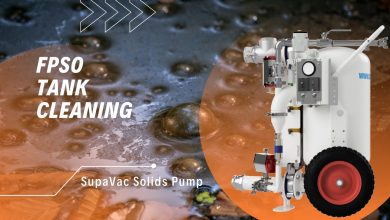
The fourth problem is manpower and downtime pressure. Dirty transfer jobs are necessary, but nobody wants them to drag on. On offshore installations, FPSO environments, or refinery-related sites, slow sludge removal can hold up more valuable work. Supavac’s FPSO tank-cleaning case study says its units achieved clean-out rates of 7 to 10 tanks per day per crew and reduced the timeframe for sludge removal while requiring only half the manpower compared with the traditional method used by the operator. That is not an Angola-specific case study, so it should not be marketed as one, but it does show why the technology category is attractive for offshore markets like Angola where cleaning time is expensive.
Why Conventional Pumping Often Fails in Angola
The wrong pump fails long before the brochure says it should. That is the truth.
A standard pump may be fine when the material is relatively thin and clean. But Angola’s offshore and refinery-related waste streams are not always clean, and often not even consistently fluid. Once you have settled solids, sludge, oily residue, slops, or abrasive contamination, the system starts fighting the material instead of moving it. Suction becomes unreliable. Blockages become more likely. Operators spend time clearing interruptions. Hose management becomes more frustrating. Job duration increases. Labour exposure increases. The site spends more time dealing with the pumping system than with the original maintenance task.
That is why “just use a pump” is not a strategy. The job requires a system designed for difficult material, not a best-case assumption.
This matters even more in Angola because offshore and oilfield maintenance work is rarely done for convenience. It is done because something needs to be cleaned, recovered, transferred, or made safe. If the transfer method is weak, the whole task expands in cost and complexity.
Where Supavac Pumps in Angola Fit Best
Offshore sludge and slops handling
Angola’s offshore profile makes this the strongest angle. Supavac’s published offshore applications include drill cuttings transfer, mud transfer, waste management solids control, hazardous waste recovery, spill management, slops sump and pit cleaning, and tank cleaning. That is exactly the kind of language that connects with offshore operating pain.
FPSO and marine tank cleaning
Supavac also explicitly lists FPSO tank cleaning and desludging, bilge cleaning, vacuum cleaning of barge and vessel bottoms, and hull-cleaning waste recovery. Angola’s offshore and marine-linked oil operations make those applications commercially relevant rather than theoretical. If a site is dealing with sludge accumulation or marine waste recovery, this is one of the clearest product-to-problem fits.
Refinery tank cleaning and residue transfer
With Lobito refinery still being developed and downstream operations remaining strategically important, the angle around tank cleaning, petrochemical tank cleaning, slops sump cleaning, heavy crude transfer, and oil sludge transfer makes sense. This is not about claiming every refinery operation needs the same system. It is about recognising that difficult residue handling is a recurring maintenance burden and that the wrong transfer setup prolongs that burden.
Hazardous waste recovery and spill response
Supavac directly lists hazardous waste recovery and spill management among its applications. In a hydrocarbon-heavy operating environment, that is one of the most commercially useful positioning points because buyers do not need a lecture about why spills and contaminated residues are a problem. They already know. What they need is equipment that helps recover and transfer difficult material efficiently and more safely.
Which Supavac-Type Solution Deserves Attention?
This is where the conversation becomes practical.
For tank-bottom residue, heavy sludge, and more serious refinery or offshore cleaning work, the SV250V is an obvious discussion point because Supavac describes it as designed to transfer an extremely wide array of heavy sludges through 100 mm suction and discharge lines with vertical suction lift up to 30 metres. That is not a light-duty positioning statement. It is built for ugly material.
For harsher, higher-density slurry or solids capture work, the SV280V and SV510 become more relevant because Supavac describes them as heavy-duty solids pumps capable of capturing high-density slurries using strong vacuum and high-velocity airflows. That matters when the material is no longer just “dirty liquid” and starts behaving like heavy, solids-rich waste.
For sites that need mobility and flexibility rather than a larger heavy-duty setup, the SV110-V2 deserves attention because Supavac positions it for applications such as oil spill capture and transfer, hazardous waste recovery, drilling mud and cuttings transfer, and industrial or municipal cleaning work. For Angola, that makes it relevant for more deployable offshore support or maintenance use cases.
The commercial point is simple: not every Angolan operation needs the same model, but the market absolutely has transfer problems that fit this product family.
Why Buyers in Angola Would Care
No serious buyer in Angola wants another piece of equipment that looks impressive on paper and then struggles in the real job. They care about whether the system:
- handles difficult sludge and solids,
- reduces manual handling,
- cuts cleanout time,
- works in hazardous and awkward environments,
- and makes recurring maintenance less painful.
That means the real targets are:
- offshore operations teams,
- maintenance managers,
- HSE leaders,
- marine support contractors,
- refinery maintenance planners,
- and procurement teams sourcing for difficult transfer applications.
Those people are not buying a story. They are buying less downtime, fewer stoppages, safer recovery, and more practical cleaning.
That is exactly why Supavac pumps in Angola should be positioned around the operational headache they remove, not the machine itself.
Final Thought
Angola’s oil and gas sector is still moving. Offshore activity remains relevant, new gas production has started, offshore assets are changing hands, and refinery expansion continues to be a national priority. All of that creates one unavoidable reality: sludge, residues, waste streams, cuttings, slops, and contaminated solids still have to be handled properly.
That is why the conversation around Supavac pumps in Angola is a practical one, not a branding exercise. Supavac’s documented applications line up directly with offshore drilling waste, hazardous waste recovery, tank cleaning, marine cleaning, spill response, and heavy sludge transfer. In other words, the product is relevant because the problem is real.
If the goal is to move difficult material faster, reduce maintenance pain, and handle sludge and solids more effectively in offshore, marine, and refinery-linked environments, then this is not a theoretical solution. It is a serious one.
Need a Practical Sludge and Solids Handling Solution?
If your operation in Angola is dealing with offshore sludge, tank-bottom residue, contaminated waste, sump buildup, bilge cleaning, spill recovery, or other solids-heavy transfer challenges, the right pumping system can make a serious difference in safety, speed, and maintenance efficiency. For technical discussions, product guidance, or application-based support on Supavac pumps in Angola, contact Takmeel Global General Trading LLC.
Takmeel Global General Trading LLC
Office #315, Makatib Building
PO Box 85250, Port Saeed
Deira, Dubai, UAE
Phone: +971 52 692 2575 | +971 04 256 4920
Email: info@takmeeltrading.com